
Stop, Consider, Explore: A practical framework for AI in schools
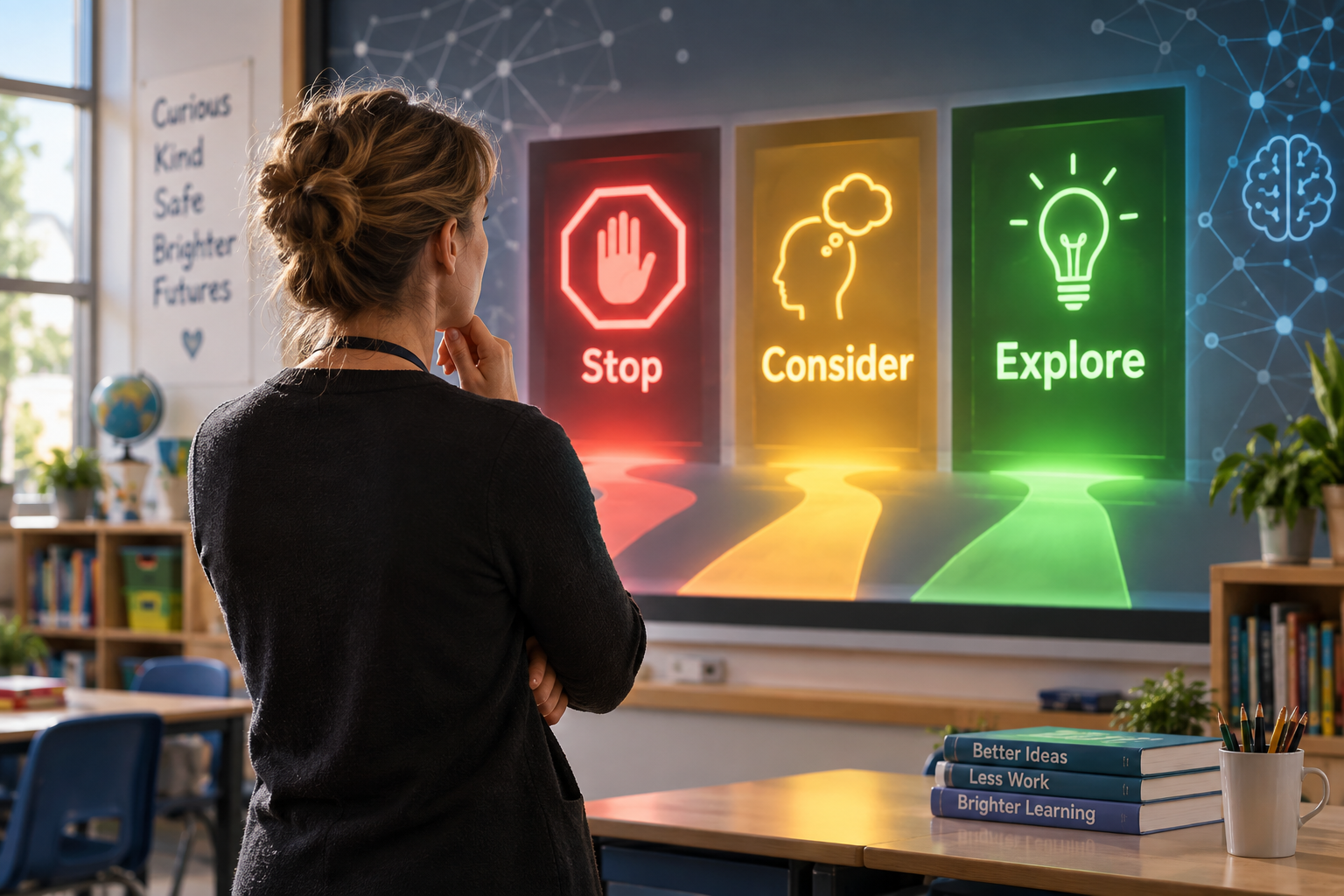
A simple three-stage framework to help school leaders set clear AI boundaries while preserving professional judgement, experimentation and innovation.
We, as schools, do not need another 20-page policy attempting to anticipate every possible use of artificial intelligence. It is useful to have some clear boundaries.
One of the challenges of leading AI adoption at the moment is that we are trying to govern a technology while simultaneously discovering what it can do. New tools appear, existing ones change and teachers find uses for them that nobody writing a policy six months earlier could reasonably have anticipated (and that is if they even tell you what they are doing).
The response cannot be to wait until everything settles down. Nor should it be to write increasingly detailed rules every time something changes.
Instead, perhaps schools need something much simpler:
Stop. Consider. Explore.
Three categories that establish the school's boundaries while leaving professionals enough freedom to discover where AI can genuinely improve education.
The idea has been prompted in part by reading about Beijing's latest approach to AI in education. Its 2026 guidance uses a traffic-light system to distinguish between prohibited, restricted and encouraged uses of AI. We don't need to import another education system's rules, but the simplicity of that structure is worth considering.
What would our own version look like?
Policy as guardrails
We sometimes talk about policy as though its purpose is to provide an answer to every situation. This will stifle innovation.
No policy can anticipate every circumstance, and attempts to do so tend to produce lengthy documents that become increasingly difficult for the people expected to use them.
This is particularly problematic with AI because the technology is developing so rapidly.
A school's AI policy should instead represent its best informed position at this moment in time.
It should be educated, referenced and carefully considered. But it should also be understood as something that will change.
We already work this way in other areas of education. Safeguarding practice, for example, has evolved as technologies, risks and our understanding of those risks have changed. Policies are reviewed because our knowledge develops.
AI should be no different.
The leadership challenge is therefore not to predict every future use of artificial intelligence. It is to provide sufficiently clear guardrails that staff understand where they have freedom to exercise professional judgement and where the school's boundaries lie.
That is where Stop – Consider – Explore might help.
STOP
Some boundaries need to be unmistakable.
Personal data is an obvious example.
Staff should not enter identifiable or sensitive information about children into general AI systems that have not specifically been approved and designed to process that information safely.
In many cases there is no reason to do so anyway.
A teacher might want ideas about approaches that could support a child with a particular learning need. AI may be able to suggest a range of strategies without knowing the child's name, date of birth, address or any other information that identifies them.
The useful information is the educational problem, not the child's identity.
The Stop category should therefore contain the relatively small number of areas where the school wants absolute clarity.
It might also include decisions where responsibility must remain human: significant safeguarding judgements, for example, or allowing AI to make an autonomous high-stakes assessment or developmental decision about a child.
AI might support the professional. It does not inherit the professional's responsibility.
Keeping this category relatively small matters. If everything slightly uncertain becomes a Stop, the policy becomes a prohibition framework rather than an innovation framework. I am sure that some of your reading this are working in such an environment.
The purpose is to identify genuine red lines.
CONSIDER
This is probably the most important category.
Consider does not mean:
Ask a senior leader for permission.
If every potentially interesting use of AI has to travel through an approval process, schools risk suppressing precisely the experimentation from which their best uses of the technology may emerge.
The classroom teacher experiencing a problem every day may be much better placed to recognise the potential of a new tool than a senior leader several steps removed from it.
Consider should instead mean:
You can use your professional judgement, but think carefully about what you are doing. Understand the safeguards. Remain responsible for the outcome. Seek advice when you are unsure.
Lesson planning is a good example.
There is little reason why a teacher shouldn't ask AI to review a lesson, suggest improvements, identify alternative approaches or consider how it might connect more effectively with wider curriculum objectives.
But the teacher still owns the lesson. The same principle applies to assessment.
We are already seeing tools capable of reducing some of the considerable workload associated with marking and feedback. There is real potential here.
But teachers also need to continue exercising assessment judgement themselves.
If all of that thinking is gradually transferred to machines, there is a danger that teachers become less practised at recognising what good assessment looks like, and consequently less able to recognise when automated assessment has got something wrong.
This gives us a useful principle that applies to both adults and children:
AI should support thinking, not routinely substitute for it.
For teachers, that might mean offloading some of the production work while retaining professional judgement.
For pupils, it might mean asking whether an AI activity increases the amount and quality of thinking a child does or simply removes the difficult part of the task.
“Think first, AI second” won't fit every situation, but it isn't a bad default.
EXPLORE
Then there should be areas where leaders explicitly give staff permission to experiment.
This is important. A policy that only tells people what they cannot do inevitably makes AI feel like another organisational risk to be managed. There are also opportunities.
Creating classroom resources is an obvious one. If you haven't tried it both Claude and ChatGPT are good at this. In my experimenting Claude has the edge.
A teacher who knows what they need can often produce or adapt a resource considerably faster with AI assistance than starting from a blank page. Routine communications can be drafted or rephrased quickly. Existing lesson ideas can be enhanced. Resources can be adapted for different contexts. Teachers can ask for alternative explanations, examples or approaches to a topic and then select those they believe will work for their pupils.
None of these activities removes the teacher from the process.
Instead, AI reduces the amount of time spent on relatively routine production while leaving the professional to decide what is worth using.
Reducing teacher workload is a worthwhile objective in itself if it contributes to a healthier working life. But there is a second potential benefit. Primary teachers have always faced the challenge of teaching a very large number of lessons in a limited amount of time. Ideally, practice improves year after year as lessons are refined. In reality, classes change, curricula change, teachers move year groups and sometimes move schools.
There is rarely enough time to improve everything we would like to improve. If AI can reduce some of the production burden, teachers potentially have more time to think about pedagogy, respond to their particular class and concentrate on the human aspects of teaching where their expertise matters most.
The objective isn't simply to do the same job faster. It should be to create the capacity to do parts of the job better. At my school we are currently experimenting with curriculum development using AI. I will share thoughts in due course :)
Professional trust has to sit underneath it
None of this works without professional trust of course. I employ educated professionals and expect them to exercise judgement every day. AI shouldn't suddenly cause us to abandon that principle. I find it maddening that some trusts have taken to banning the use of AI entirely rather than the approach suggested here. Why is it that they trust us to send emails, or even to look after 30 small people all day but not to use a chatbot. Nonsense.
If leaders need to communicate expectations clearly then staff should understand why particular boundaries exist and should have opportunities to contribute to the development of those boundaries. Once that framework is established, there has to be space for professional judgement.
That is particularly important during this stage of AI adoption because expertise isn't concentrated neatly at the top of organisations. A teacher experimenting with a particular problem may discover something genuinely valuable before anyone responsible for writing the policy has considered it. Innovation often happens because somebody close to a problem sees an opportunity.
Our governance structures need to leave enough space for that to happen.
The same framework could work for pupils
Understandably most schools and trusts are cautious about pupil use of AI. We are considering the Stop – Consider – Explore as a framework for children as well.
The precise rules would need to be age-appropriate, but the underlying habit could be valuable.
Stop: there are things we don't share or ask an open AI system to do.
Consider: think about what you are sharing, what you are asking AI to do and whether you should seek help before proceeding.
Explore: there are appropriate situations where AI can help you investigate, question, create and develop ideas.
This is potentially more durable than teaching children lists of rules about individual products. The products will change. The ability to stop, consider the context and then make an informed decision is much more transferable.
Policy development can educate the community
Schools will take different approaches to developing these frameworks because their governance structures differ.
Typically, I would expect the detailed thinking to begin with the educators closest to the issues. Governors can then provide scrutiny, challenge and additional perspectives as the framework develops. There is also a strong case for making the school's thinking visible to parents. That doesn't mean telling parents how they should use AI at home.
The evidence around many aspects of children's AI use is still developing, and schools should be appropriately cautious about presenting uncertain conclusions as established fact. But parents will increasingly face many of the same questions schools are considering.
Explaining why the school has placed particular activities under Stop, Consider or Explore gives families access to that thinking. It allows the policy-development process itself to contribute to wider AI literacy. And, importantly, those categories can change.
Something in Consider today may eventually move into Explore as evidence, technology and staff expertise develop.
Something we currently regard as relatively low-risk may move in the other direction if new problems emerge.
This would be evidence of a policy doing what it should: evolving alongside our understanding.
Start with three questions
School leaders do not need to solve artificial intelligence before they write an AI policy.
Perhaps the starting point is much simpler.
Bring together the people in your organisation who understand the educational, safeguarding, technical and governance issues and ask three questions:
What do we want people to stop doing because the risk is unnecessary or unacceptable?
Where do we want people to consider the risks, exercise particular professional judgement and seek advice when necessary?
And where do we actively want our staff to explore what AI could make possible?
Write those answers down. Pass them around your staff team/s for further comments. Engage with staff who raise questions or points.
Explain the reasoning (or revise the reasoning if the consultation has raised valid challenges or points)
Share them with the people expected to use them.
Then give professionals the freedom to work within those guardrails.
It won't produce the perfect AI policy.
There probably isn't one.
But it might produce something much more useful: a policy people can actually remember when they have to make a decision, and one that they feel like they have ownership of.
Stop. Consider. Explore.
Further reading
- Beijing Academy of Educational Sciences — Beijing Education Sector Artificial Intelligence Application Guidelines (2026). The updated framework that helped prompt this article, including its classification of prohibited, restricted and encouraged applications.
- Beijing Municipal Government — Beijing Action Plan for Promoting AI Education in Primary and Secondary Schools (2025–2027).
- China Ministry of Education — Ethics of Digital Education: A Reference Framework (2026), including principles around human decision-making, AI over-reliance and differentiated governance.
- UK Department for Education — Generative artificial intelligence (AI) in education, including guidance and expectations for schools and colleges considering the use of generative AI.
Get more like this
One practical idea, one resource, one piece of tech, weekly.